
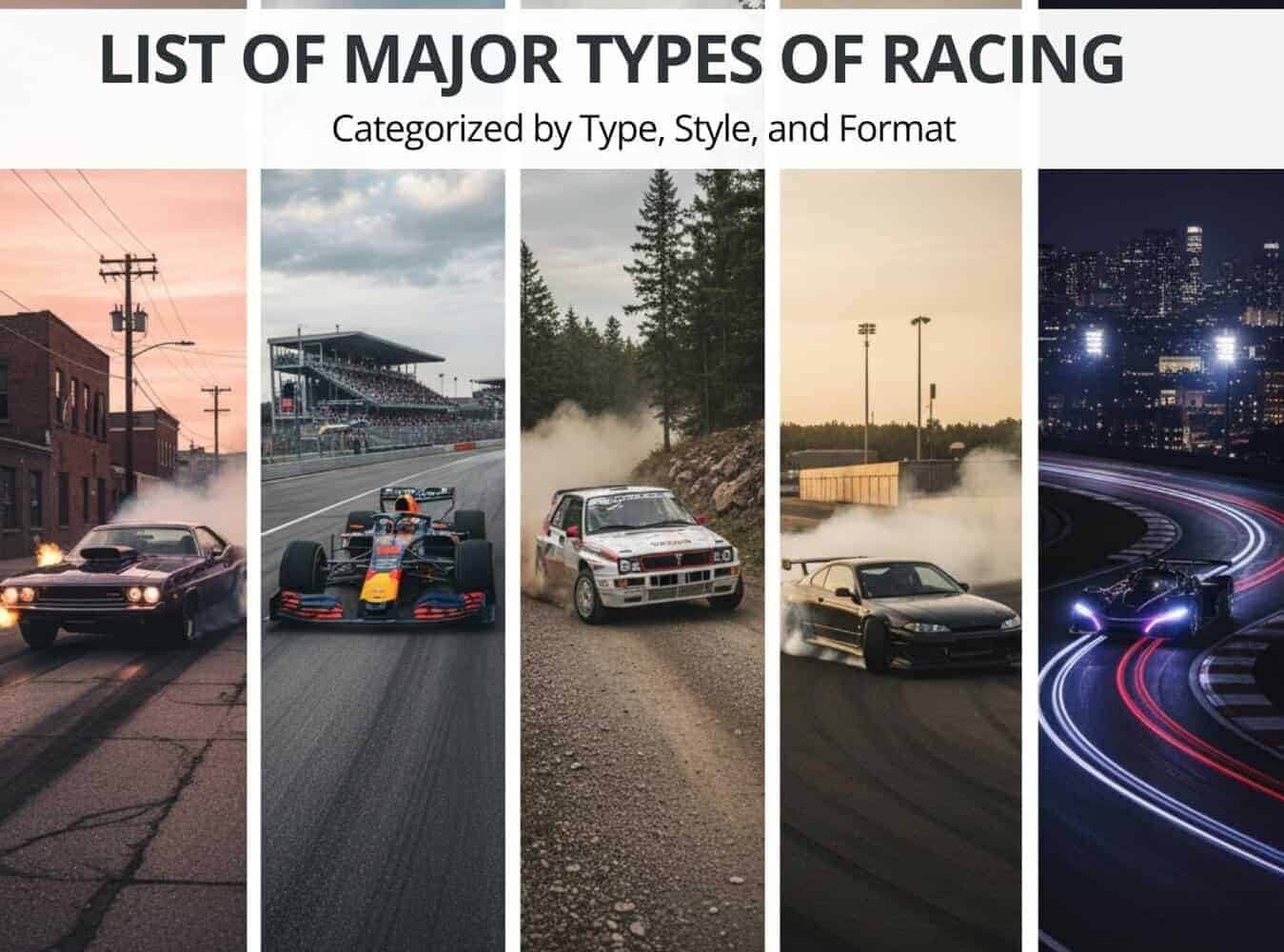
List of Major Types of Automotive Racing Categorized by Style and Format
Exploring the World of Automotive Racing
The world of automotive racing is a vast and thrilling spectacle of speed, skill, and engineering. Whether it’s the high-tech precision of Formula 1, the brutal endurance of the Baja 1000, or the stylish flair of drifting, there’s a discipline for every adrenaline junkie. This guide will navigate you through every major type of car racing, defining each category, highlighting its iconic events, and explaining what makes each format a unique test of driver and machine.
Circuit Racing
Formula (Open-Wheel)
Single-seater cars with exposed wheels and advanced aerodynamics emphasize precision and peak cornering performance.
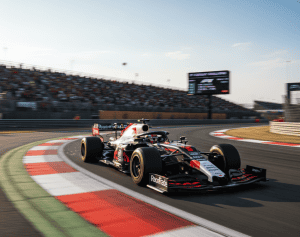
Formula Race Car Apex Turn on Circuit Track
Formula 1 (F1)
The global pinnacle of open-wheel racing, featuring hybrid power units and street plus permanent circuits. Races last ~1.5–2 hours over ~305 km 200+ mph.
Formula 2 & Formula 3
Spec-chassis feeder series to F1 that spotlight driver talent over car disparity and develop future stars.
IndyCar
North America’s premier open-wheel series with ovals, road courses, and streets — headlined by the Indianapolis 500.
Formula E
Electric single-seaters on city streets highlighting efficiency, battery strategy, and energy management.
Why it’s distinct: Highest cornering loads, pit-stop and tire strategy, and tight margins where clean air and track position matter. Formula racing events are some of the most watched racing events in the world.
Touring Car Racing
BTCC delivers elbows-out action in the UK; global TCR rulesets enable cost-controlled, close racing across national series.
Watch for: Rolling starts, reverse-grid races, and balance-of-performance (BoP) producing pack racing.
Sports Car Racing
FIA World Endurance Championship (WEC)
The home of 24 Hours of Le Mans, with Hypercar and LMGT3 classes sharing the track. Teams balance stint length, fuel/energy targets, tire double-stints, and pace management in changing conditions.
IMSA WeatherTech SportsCar Championship
U.S. endurance series with GTP prototypes and GT classes at events like the Rolex 24 at Daytona and 12 Hours of Sebring.
Multi-class racing, explained: Faster classes must overtake safely through traffic; slower classes manage mirrors and corner entry/exit to minimize time loss. Blue flags, driver etiquette, and situational awareness are critical to avoid incident chains.
Single-Make Racing
Porsche Supercup and Ferrari Challenge are benchmark series pairing spec machinery with elite venues and pro-level organization.
Why it matters: Level technical playing field → razor-thin gaps and driver development.
Stock Car Racing
NASCAR Cup Series headlines a national calendar. While appearing like their showroom counterparts, these are purpose-built race cars with tube-frame chassis optimized for speed and safety. Feeder ladders like ARCA develop talent on every level, from short tracks to superspeedways.
Keys to success: Drafting packs, pit-cycle timing, and restarts where positions can swing dramatically.
Drag Racing (incl. Street)
Top Fuel & Funny Car
Nitromethane monsters exceeding 10,000 hp; sub-4-second runs and 330+ mph terminal speeds demand perfect launches and clutch management.

Top Fuel Dragster
Sportsman & Pro Categories
From Pro Stock to bracket and index racing, classes emphasize consistency, dial-ins, and staging discipline.
No-Prep & Street-Style
No Prep Kings is a sanctioned track format on minimally prepared surfaces, prioritizing power control and chassis setup. Street-legal shootouts at tracks mimic street conditions but with safety teams and rules.
Illegal Street Racing (Unsanctioned)
Unsanctioned public-road racing poses extreme risks due to a lack of a controlled environment. Sanctioned tracks provide prepared surfaces for better traction, safety barriers, and immediate access to trained emergency crews (paramedics and firefighters), which are all absent on public roads. Risks of illegal racing include severe injury, property damage, and serious legal consequences. Keep it on the track.
Off-Road Racing
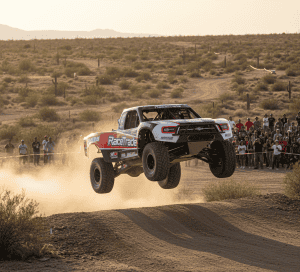
Trophy Truck Racing in Desert – Baja 1000
Baja 1000
Iconic point-to-point or loop race on the Baja California Peninsula for trophy trucks, buggies, UTVs, and bikes.
King of the Hammers
Hybrid of high-speed desert running and technical rock crawling in California’s Johnson Valley.
Short-Course Series
Stadium-style dirt tracks with jumps and tight corners emphasize suspension tuning and racecraft.
How is this different from Rally Raid? While Baja features high-speed racing on a largely marked course, disciplines like Rally Raid (see our Rally Racing section) test navigation and endurance over unmarked terrain using a roadbook, making the co-driver’s role just as critical as the driver’s.
Rally Racing
World Rally Championship (WRC)
Factory-backed teams tackle multi-surface events like Monte Carlo and Finland; time is accumulated across special stages.
Rallycross
Short, mixed-surface sprints with tight grids, jumps, and joker laps — high intensity and door-to-door battles.
Rally Raid / Dakar Rally
Dakar Rally exemplifies cross-country navigation over thousands of kilometers with roadbooks, speed zones, and marathon stages testing endurance for crews and machines.
Why it’s unique: Co-driver navigation, surface changes within events, and car preservation under parc fermé constraints.
Time Attack / Time Trial
Global Time Attack and Super Lap Battle host classes from street to unlimited, emphasizing aero efficiency, braking stability, and thermal management for repeat flyers.
Drift Racing
Formula Drift (U.S.) and D1 Grand Prix (Japan) set the competitive standard with tandem battles that test commitment and proximity.
Hill Climb Racing
Pikes Peak International Hill Climb (“Race to the Clouds”) climbs 12.42 miles to 14,115 ft with 156 turns — aero and power delivery are tuned for altitude.
Autocross
SCCA Solo classes range from Street to Street Modified, teaching vision, weight transfer, and precision at accessible speeds.
Ice Racing
Regional associations (e.g., IIRA) run multi-class programs on lakes with strict safety checks and surface evaluations.
Kart Racing
SKUSA and CIK-FIA ladders develop talent from junior to gearbox categories; racecraft and race starts translate directly to cars.
Electric Vehicle Racing
Formula E showcases energy-limited strategy on city circuits; Extreme E brings spec SUVs to remote venues with environmental storytelling.
Historic & Classic Racing
Goodwood Revival and HSR events blend competition with heritage, often featuring legends and rare chassis.
Sim Racing (eSports)
iRacing, Gran Turismo Championships, and Forza host ranked series that mirror real-world race formats and endurance protocols.

Sim Racing Sports
Cross-Country Racing
Rally Raid is the formal discipline (see Rally Racing for Dakar). Baja racing emphasizes speed over marked desert courses with limited navigation.
Your Guide to the Grid
From the grassroots accessibility of autocross to the global stage of Formula 1, the world of motorsport offers a diverse spectrum of competition. Each discipline challenges drivers and machines in unique ways, creating unforgettable moments of triumph and drama. No matter what fuels your passion, the perfect type of racing is out there waiting.
